Apple Eyes a 15-Year First: The AI Server Gambit 📌
Apple (AAPL +0.32%) is reportedly evaluating a move that would break a 15-year silence. According to The Information, the Cupertino giant is weighing development of its own AI inference server, marking its first foray into enterprise server hardware since discontinuing the Xserve line back in 2011.
The proposal, reportedly championed by newly appointed CEO John Ternus, would fuse Apple's custom silicon with Nvidia's (NVDA +0.81%) NVLink Fusion interconnect technology. The servers would ship with either two or four M8 Ultra chips — Apple's top-tier processors — purpose-built for AI inference workloads.
For investors, this isn't just a product rumor. It's a signal that Apple may be preparing to compete in the same capex-heavy arena where Microsoft, Meta, Amazon, and Alphabet have already committed hundreds of billions. 🚨
The Technical Backbone: Why NVLink Matters
At the heart of the proposal sits Nvidia's NVLink Fusion technology. Unlike conventional PCIe interconnects, NVLink enables direct GPU-to-GPU data transfer at blistering speeds. Nvidia claims its fourth-generation NVLink pushes 900 GB/s — roughly 7x the bandwidth of standard x86 server connections.
Key Specs Under Consideration
- Chip Configuration: 2x or 4x M8 Ultra per server
- Interconnect: Nvidia NVLink Fusion (optional per reports)
- Workload Focus: AI inference (not training)
- Target Availability: 2029
Apple engineers reportedly view Nvidia's interconnect as best-in-class, though the server could theoretically be built without it. Ternus, previously SVP of Hardware Engineering, reportedly backed the initiative a year before assuming the CEO role — a detail that suggests this isn't a fleeting experiment.
The Strategic Subtext
Apple hasn't touched server hardware since 2011, when it killed Xserve and redirected resources toward consumer devices. Re-entering now would mark a philosophical shift: from AI-on-device to AI-in-the-datacenter. 📌
The Street is split on whether this signals a genuine strategic pivot or just exploratory R&D. Here's how both sides are framing it:

The Financial Picture: Cash Machine vs. Capex Race
Here's where Apple's story diverges sharply from its Magnificent Seven peers. While Microsoft, Tesla, Meta, Amazon, and Alphabet have been burning billions on GPUs, data centers, and connectivity, Apple has largely sidestepped the capex arms race — and it shows in the numbers.
| Metric | Apple (AAPL) | Peer Context |
|---|---|---|
| Market Cap | $4.8T | Largest in Magnificent Seven |
| TTM Free Cash Flow | $136.7B | Higher than Nvidia's |
| FCF Trend | Rising | Peers' FCF declining on AI capex |
| Gross Margin | 48.65% | Best-in-class hardware margins |
| Dividend Yield | 0.32% | Modest but sustainable |
| Q3 Revenue | $109.41B | Net income $29.78B |
The Core Tension
Every other Magnificent Seven member saddled with AI infrastructure capex is watching free cash flow compress. Apple, by contrast, has kept its FCF expanding — a direct benefit of its asset-light AI strategy (embedding third-party AI into iOS rather than building foundational models).
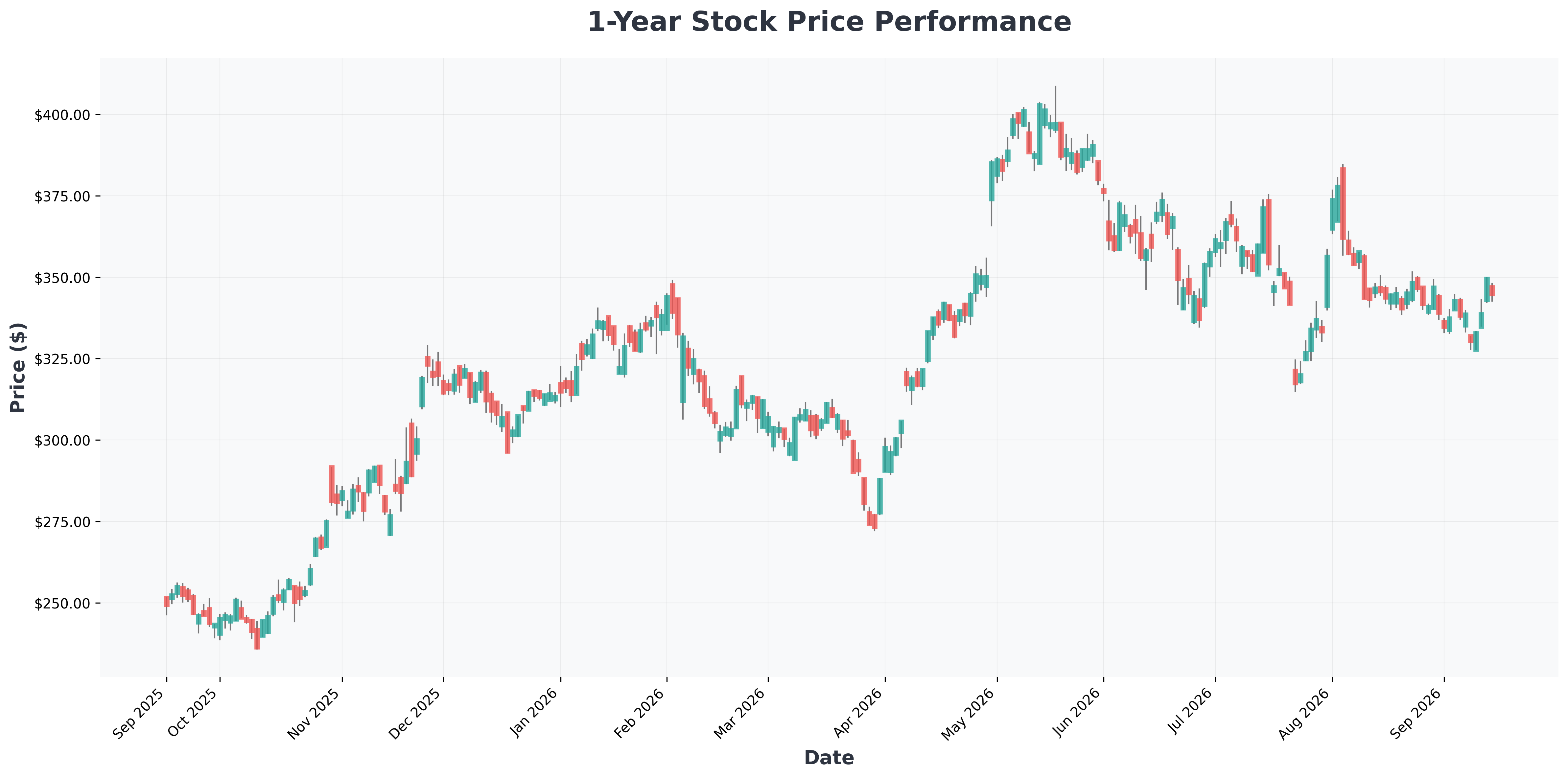
Technical Context: AAPL's 52-week range sits at $236.65–$344.57, with the stock trading near the upper band. A confirmed server initiative would likely be treated as a long-duration call option — meaningful for 2029+ earnings, but not a near-term catalyst. Historically, Apple's most transformative pivots (iPhone 2007, Services 2015) took 3–5 years to show up in the P&L.
Backtesting Insight: When Apple announced its transition to Apple Silicon in 2020, the stock traded sideways for two quarters before repricing higher. Investors expecting an immediate AI-server premium may be disappointed — the market typically waits for execution proof.
📊 In-Depth Fundamental Analysis
| Company | Share Price | P/E Ratio | P/B Ratio | ROE | Operating Margin (OPM) | Revenue Growth |
|---|---|---|---|---|---|---|
| AAPL (Apple) | $332 | 38.16 | 45.16 | 148.75% | 32.62% | 16.40% |
| AMZN (Amazon.com,) | $246 | 19.80 | 4.81 | 30.56% | 13.69% | 19.60% |
| GOOG (Alphabet) | $339 | 17.02 | 6.67 | 48.68% | 34.03% | 24.20% |
| GOOGL (Alphabet) | $343 | 17.20 | 6.74 | 48.68% | 34.03% | 24.20% |
| META (Meta) | $673 | 25.37 | 6.57 | 29.85% | 34.83% | 28.00% |
| MSFT (Microsoft) | $490 | 27.31 | 8.23 | 34.04% | 45.11% | 17.70% |
| NVDA (NVIDIA) | $214 | 27.04 | 22.56 | 117.21% | 66.24% | 105.90% |
| TSLA (Tesla,) | $358 | 334.65 | 16.28 | 4.67% | 1.41% | 25.50% |
Scenario Analysis: Bull vs. Bear Roadmap
🐂 Bull Case
- Apple enters enterprise AI servers with best-in-class custom silicon + Nvidia interconnect
- Ternus establishes early strategic vision, diversifying beyond consumer hardware
- $136.7B FCF funds the buildout without straining the balance sheet
- Long-term: Apple becomes a vertically integrated AI infrastructure player
🐻 Bear Case
- 2029 timeline is far off; competitive landscape will have shifted dramatically
- Enterprise server business has thin margins vs. Apple's 48.65% gross margin profile
- Nvidia partnership could create dependency rather than differentiation
- Risk that this remains a skunkworks project that never ships
Key Levels to Watch
- Support: $330 (recent consolidation zone)
- Resistance: $344.57 (52-week high)
- Catalyst Trigger: Any official confirmation from Apple IR or supply chain leaks
Bottom Line: This is a strategic signal, not a tradeable event. Apple's FCF strength gives it optionality most peers lack, but investors should treat the AI server story as a 2029 thesis — not a 2025 trade. Position sizing should reflect that duration. 📌