The Neocloud Boom Meets a Reality Check 🚨
The AI boom birthed a new class of high-flying companies: neoclouds — firms that rent out computing capacity powered by advanced chips. But Elon Musk just threw cold water on the party, warning that more than 200 neocloud providers could face widespread failures and consolidation as financing tightens.
For investors, this raises the million-dollar question: Is this a red flag to avoid neocloud stocks entirely, or a setup for buying opportunities? 📌
The answer isn't binary. The AI opportunity remains real — but the winners won't be decided by growth rates alone. Financial resilience, business economics, and valuation discipline will separate the survivors from the casualties.

Demand for AI Compute ≠ Shareholder Returns
The bull case for neoclouds is seductive. As enterprises adopt AI, demand for computing power could expand for years. Names like CoreWeave (CRWV) and Nebius are positioning themselves to capture that demand by renting out capacity built on cutting-edge processors.
But supplying compute is brutally expensive. Neoclouds must pour capital into chips and data centers before earning the revenue those investments are meant to generate. Add rising borrowing costs and the risk that expensive equipment depreciates as newer tech arrives, and the picture gets complicated.
Take CoreWeave. Its revenue backlog ballooned to roughly $104 billion by the end of Q2 2026 — an eye-popping figure. Yet investors remain nervous about its substantial financing needs and the cost of expanding infrastructure. A backlog is expected future business, not cash in the bank or profit already earned. 📉
That distinction matters. A company can win customers and grow revenue rapidly without generating enough cash to justify the capital sunk into the business.
So instead of chasing growth headlines, ask three questions:
- How much capital does the company need to keep expanding?
- How much cash does the existing business actually generate?
- Will the returns from infrastructure justify the cost of financing it?
Those answers matter far more than a growth rate.
This is exactly where the market splits — let's look at both sides of the neocloud debate.

The Domino Effect of a Financing Crunch
Musk's warning spotlights a risk that snowballs when lenders turn cautious. Neoclouds often borrow to buy chips and build data centers. If financing gets more expensive or harder to secure, some providers may delay projects, issue more shares, or sell assets to raise cash.
The damage can spread beyond the struggling companies. Picture several providers hitting financial trouble at once. Some may dump computing equipment to repay creditors. If enough capacity floods the market, competition intensifies and prices for computing services come under pressure — hurting even the survivors.
The opposite is also possible. AI demand could grow fast enough to absorb extra capacity while stronger players scoop up assets and customers from weaker rivals. Consolidation might even improve long-term industry economics.
But don't assume every survivor wins. A company that emerges from a shakeout can still deliver poor shareholder returns if it overpaid for infrastructure or took on excessive debt.
Key Metrics to Watch 📌
| Metric | Why It Matters |
|---|---|
| Debt load | High leverage amplifies risk in a financing crunch |
| Operating cash flow | Reveals whether growth is self-funding or debt-dependent |
| Interest expense | Rising costs squeeze margins fast |
| Capex commitments | Future spending obligations can strain liquidity |
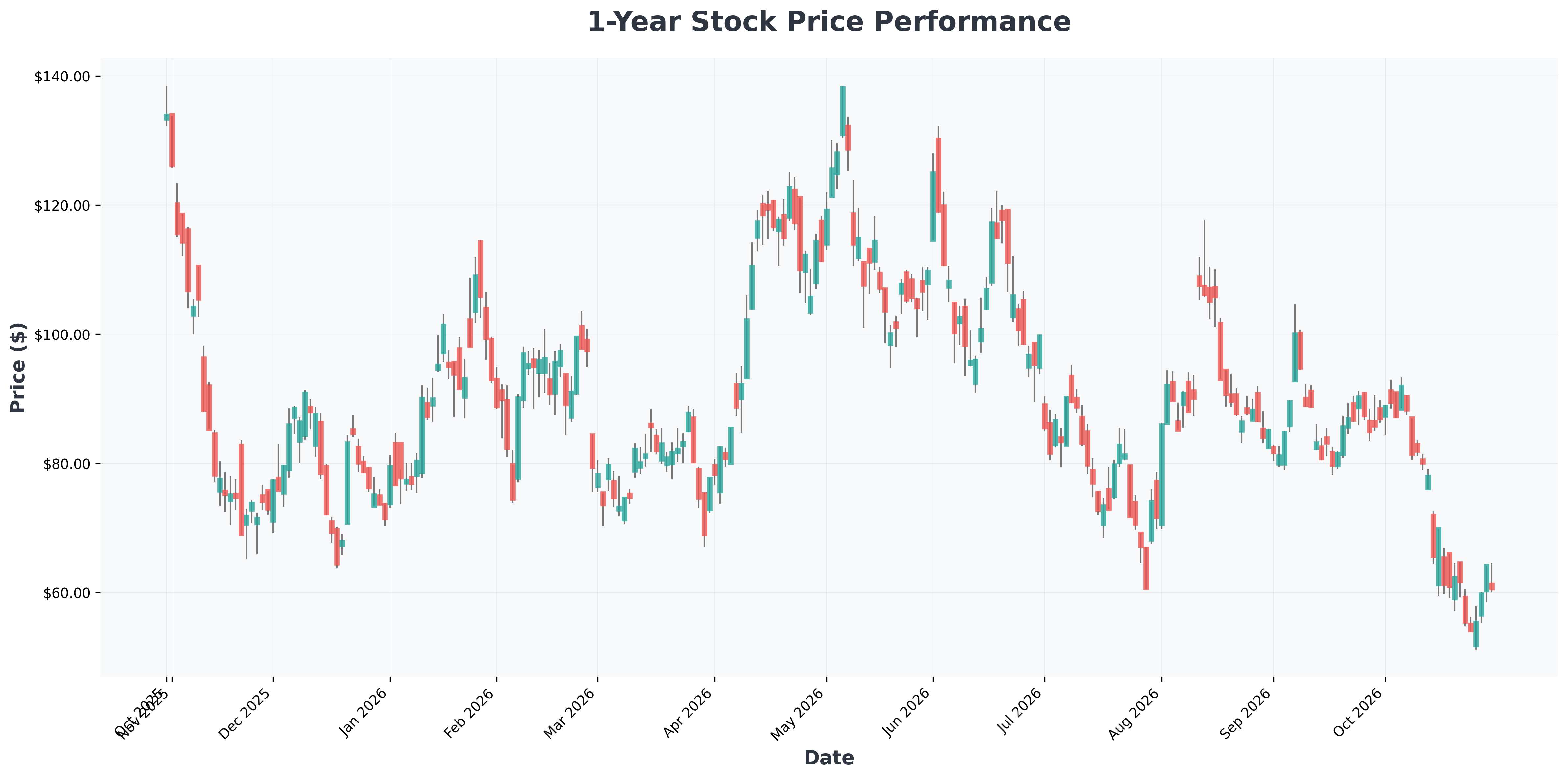
No single number tells the whole story — but together they reveal whether growth is strengthening the business or making it more fragile. From a technical standpoint, names like CRWV trading well below their 52-week highs ($138.36) suggest the market is already pricing in financing risk; watch whether the $51–$55 zone holds as a support floor, since a break below could accelerate the shakeout narrative.
📊 In-Depth Fundamental Analysis
| Company | Share Price | P/E Ratio | P/B Ratio | ROE | Operating Margin (OPM) | Revenue Growth |
|---|---|---|---|---|---|---|
| AMZN (Amazon.com,) | $240 | 19.34 | 6.27 | 30.56% | 13.69% | 19.60% |
| CRWV (CoreWeave,) | $55 | 0.00 | 6.02 | -43.60% | -1.90% | 112.50% |
| GOOG (Alphabet) | $278 | 14.53 | 5.19 | 44.29% | 31.80% | 24.70% |
| GOOGL (Alphabet) | $280 | 14.61 | 5.22 | 44.29% | 31.80% | 24.70% |
| MSFT (Microsoft) | $522 | 27.24 | 8.76 | 34.22% | 49.76% | 18.80% |
| NBIS (Nebius) | $154 | 120.42 | 4.09 | 0.60% | -0.22% | 454.00% |

Where the Real AI Opportunities Hide
Investors don't need to own neoclouds to profit from AI computing growth.
Hyperscalers like Microsoft, Amazon, and Alphabet run cloud infrastructure alongside diverse revenue streams. Their cloud arms aren't purely AI-focused — plenty of capacity serves general enterprise workloads — but they're building AI clouds fast, funded by existing cash-generating businesses. That said, even they aren't guaranteed attractive returns on those investments.
Infrastructure suppliers offer another path. Semiconductor and networking companies sell essential components to countless data center operators, letting investors benefit from expanding data center capex without shouldering the same financial risks as the firms building and operating those facilities.
Best vs. Worst Case Scenarios
| Scenario | Outcome |
|---|---|
| ✅ Best Case | AI demand absorbs excess capacity, strong neoclouds acquire weaker rivals, consolidation improves industry economics, and disciplined investors buy resilient names at reasonable valuations |
| ⚠️ Worst Case | Financing dries up, multiple providers dump equipment, compute prices collapse, survivors still deliver poor returns due to overpayment and debt burdens |
The Bottom Line
Musk's warning isn't a reason to abandon AI stocks — it's a reason to be selective. Demand for computing power could keep expanding, and some neoclouds may emerge stronger from consolidation. But a growing market doesn't guarantee every company survives or creates shareholder value.
Prioritize financial resilience, attractive business economics, and reasonable valuations over headline growth. For highly leveraged neoclouds, demand a larger margin of safety. You don't need to predict exactly who fails — just identify businesses that can withstand tougher conditions and buy them at prices that leave room for mistakes. 💡