The AI semiconductor boom is the defining economic story of our time. While all eyes are on the flashy chip designers like Nvidia (NVDA) and AMD, the real power lies upstream. Let's cut through the noise and look at why Taiwan Semiconductor Manufacturing (TSMC) is the true linchpin of this revolution. 📌
TSMC doesn't just design chips; it manufactures them for almost everyone who matters. This unique position gives it unmatched pricing power and diversified growth that pure-play designers can only dream of.

The Linchpin of the AI Ecosystem 🏭
Nvidia and AMD are fabless, meaning they rely on TSMC's cutting-edge fabs to bring their designs to life. But TSMC's client list doesn't stop there. They also power Apple, Qualcomm, Broadcom, and even the hyperscalers like Amazon and Microsoft. This diversification is a massive advantage.
Why this matters for investors:
- Revenue Growth: TSMC's revenue for the first seven months of 2026 is up 37% YoY, with July alone showing a 45% spike. This is a clear sign that the AI demand is accelerating, not slowing down.
- Pricing Power: As the only game in town for 3nm and 2nm chips, TSMC is reportedly planning a 25% price hike for additional AI chip orders next year. That's on top of a standard 5-10% increase. This is a direct line to higher margins and earnings.

The Valuation Question: Is It Too Late?
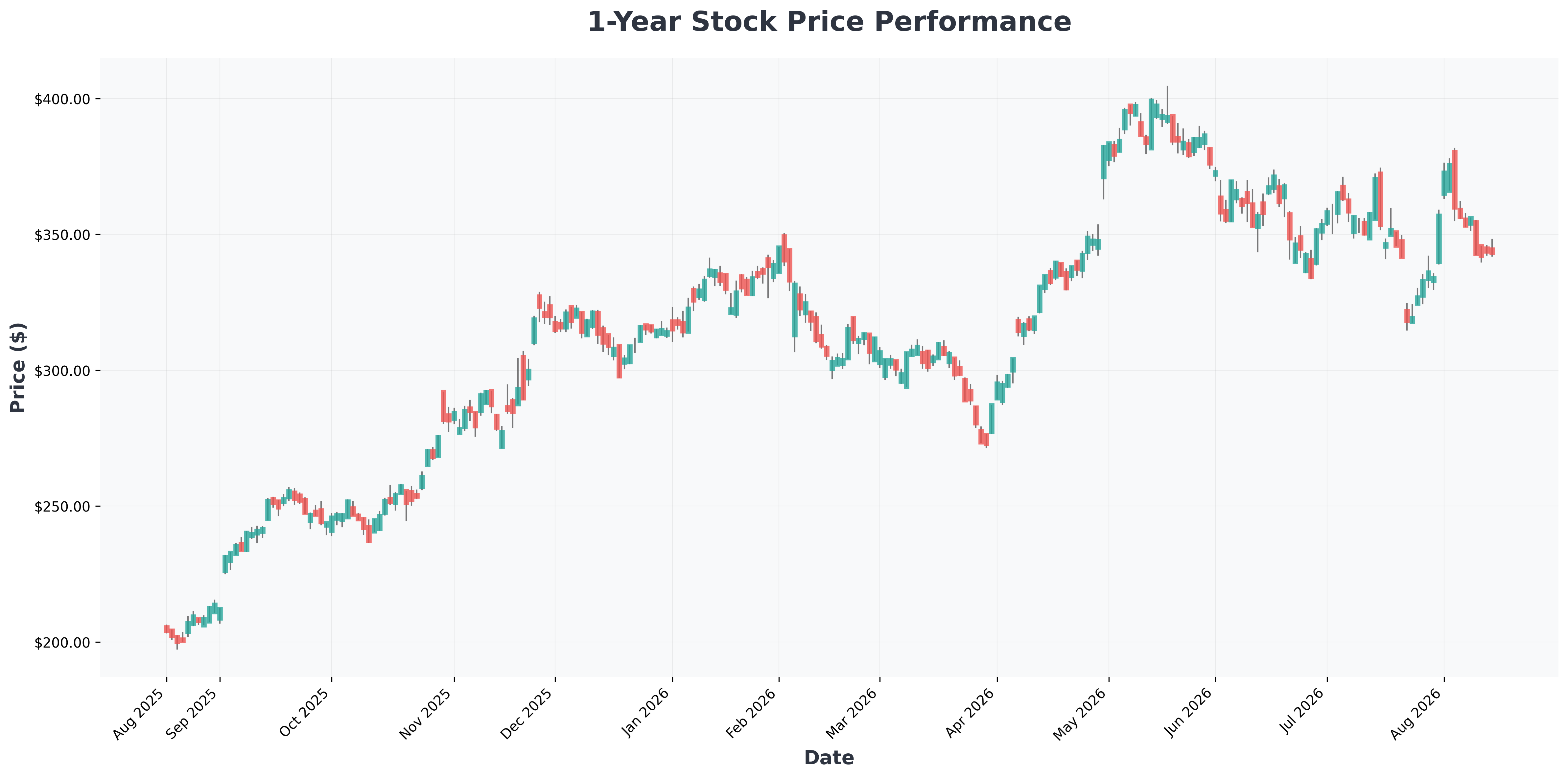
Despite a 76% surge in the past year, the stock trades at a reasonable 25 times forward earnings. To put that in perspective, the iShares Semiconductor ETF (SOXX) trades at a P/E of 67, and AMD sits at 63. You are getting the market leader at a massive discount. 💰
The Bull vs. Bear Case: A Market Divided
This is where the market's opinion splits, and it's a healthy debate for any investor to consider.
This is where the market's opinion splits, and it's a healthy debate for any investor to consider.
📊 In-Depth Fundamental Analysis
| Company | Share Price | P/E Ratio | P/B Ratio | ROE | Operating Margin (OPM) | Revenue Growth |
|---|---|---|---|---|---|---|
| AAPL (Apple) | $306 | 35.08 | 41.57 | 148.75% | 32.62% | 16.40% |
| AMD (Advanced) | $514 | 131.56 | 12.49 | 10.20% | 17.25% | 50.10% |
| AMZN (Amazon.com,) | $263 | 21.15 | 5.13 | 30.56% | 13.69% | 19.60% |
| AVGO (Broadcom) | $393 | 65.39 | 21.32 | 37.28% | 48.99% | 47.90% |
| GOOG (Alphabet) | $344 | 17.24 | 6.75 | 48.68% | 34.03% | 24.20% |
| GOOGL (Alphabet) | $346 | 17.36 | 6.80 | 48.68% | 34.03% | 24.20% |
| MSFT (Microsoft) | $495 | 27.63 | 8.32 | 34.04% | 45.11% | 17.70% |
| NVDA (NVIDIA) | $225 | 34.48 | 27.90 | 114.29% | 65.60% | 85.20% |
| QCOM (QUALCOMM) | $166 | 18.95 | 6.34 | 33.75% | 18.53% | -4.00% |
| TSM (Taiwan) | $426 | 32.15 | 88.92 | 39.97% | 60.34% | 36.00% |

Scenario & Conclusion: The Path to $848? 📈
Let's model a potential scenario. If TSMC trades at a still-conservative 30 times earnings by the end of 2028, and its earnings per share (EPS) reaches $28.26, the stock would hit $848. That's nearly double the current price.
Best Case: AI adoption accelerates beyond expectations, 2nm demand skyrockets, and TSMC's pricing power drives EPS to $30+. The stock could easily surpass $900.
Worst Case: A global recession hits capital spending, causing a temporary slowdown. However, TSMC's contractual backlog and dominant market share (73%) provide a significant buffer, likely limiting downside to around $350.
The Bottom Line: While Nvidia and AMD are great companies, TSMC offers a more balanced and less risky way to play the AI boom. With its monopolistic-like market share, aggressive pricing power, and attractive valuation, it stands out as the biggest winner in the long run. 🚨 Investing involves risk, and past performance is not indicative of future results. Always do your own research.