The S&P 500's average dividend yield sits near a two-decade low at roughly 1%, making it brutally tough for income investors to generate meaningful passive cash flow from traditional index funds. 📉 But why settle for pennies when there's a niche group of stocks handing out double-digit yields? 🕵️♂️
We're digging into three ultra-high-yield plays that stand out from the crowd this August: AGNC Investment (AGNC), Ares Capital (ARCC), and Western Midstream Partners (WES). These aren't your average blue-chip dividend payers—they come with unique structures (REITs, BDCs, and MLPs) and a higher degree of risk. Let's break down what makes them tick and whether they deserve a spot in your portfolio.

AGNC Investment (AGNC): The 13.5% Monthly Payer 📌
AGNC Investment is the heavyweight champion of income, currently yielding an eye-popping 13.5%+. As a mortgage REIT, it doesn't own office buildings or malls. Instead, it exclusively invests in Agency MBS—pools of residential mortgages guaranteed by government-sponsored enterprises like Fannie Mae and Freddie Mac. 🏠
This government backing makes the underlying assets relatively low-risk, but here's the twist: AGNC uses significant leverage (borrowed money) to amplify returns. This strategy supercharges the yield but also makes the stock highly sensitive to interest rate movements. 📊
The Bull Case: AGNC has maintained its current monthly dividend for 75 consecutive months. Management states they're generating mid-to-high double-digit leveraged returns on new MBS investments, which comfortably covers the current payout. For investors seeking a steady monthly income stream, this track record is a powerful signal.
The Bear Cave: Leverage cuts both ways. If interest rates spike or credit spreads widen unexpectedly, the book value can take a hit, which often leads to dividend cuts in the mortgage REIT space. This isn't a 'set it and forget it' stock—it requires monitoring the macro environment.
The ultra-high yields are tempting, but are they too good to be true? Let's see what the bulls and bears are saying about this income strategy.
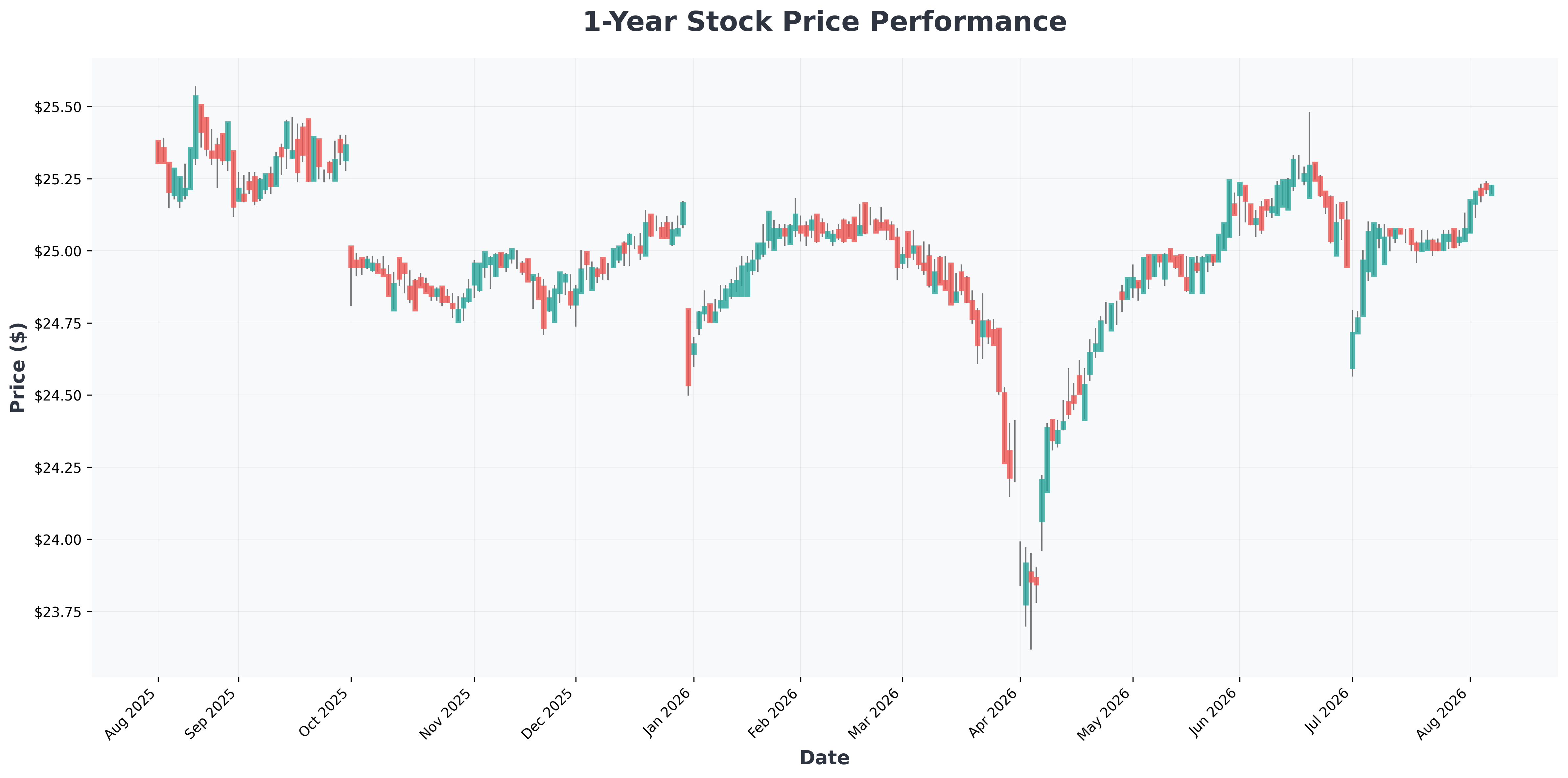

Ares Capital (ARCC): The BDC Powerhouse with a 9.6% Yield 💼
Next up is Ares Capital, a business development company (BDC) yielding nearly 9.6%. ARCC is the market leader in providing direct loans to private middle-market companies (those with $500 million to $1 billion in revenue). This niche often offers higher yields than traditional bank loans, but it comes with increased credit risk.
The Bull Case: Ares has a stellar underwriting track record. Their annualized net realized loss rate is less than 0% across $73 billion of realized investments—that's better than the average bank (-0.6%) and their BDC peers (-1.1%). 🛡️ They've paid a stable or growing dividend for 17 straight years. Even though core earnings dipped slightly below the dividend in the first half of the year, they've offset this with realized gains and have a stash of excess taxable income ($1.38 per share) to carry forward into 2026.
The Risk Factor: The stock is sensitive to the health of the U.S. economy. If we enter a severe recession, defaults among middle-market companies could rise, pressuring earnings and potentially the dividend. However, their historical loss rates suggest they're well-equipped to weather downturns.
📊 In-Depth Fundamental Analysis
| Company | Share Price | P/E Ratio | P/B Ratio | ROE | Operating Margin (OPM) | Revenue Growth |
|---|---|---|---|---|---|---|
| AGNC (AGNC) | $11 | 5.39 | 1.19 | 19.80% | 95.61% | 0.00% |
| WES (Western) | $47 | 14.75 | 5.46 | 34.11% | 41.29% | 30.00% |
| AGNCL (AGNC) | $25 | 0.00 | 2.78 | 19.80% | 95.61% | 0.00% |
| AGNCM (AGNC) | $25 | 0.00 | 2.77 | 19.80% | 95.61% | 0.00% |
| AGNCN (AGNC) | $26 | 0.00 | 2.85 | 19.80% | 95.61% | 0.00% |
| AGNCO (AGNC) | $26 | 0.00 | 2.82 | 19.80% | 95.61% | 0.00% |
| AGNCP (AGNC) | $25 | 0.00 | 2.78 | 19.80% | 95.61% | 0.00% |
| AGNCZ (AGNC) | $26 | 0.00 | 2.81 | 19.80% | 95.61% | 0.00% |
| ARCC (Ares) | $20 | 14.93 | 1.03 | 6.88% | 75.65% | 3.10% |

Western Midstream Partners (WES): The MLP Fueled by Energy Infrastructure 🛢️
Western Midstream Partners rounds out our list with a yield of nearly 8%. As a master limited partnership (MLP), WES operates critical midstream infrastructure—pipelines and processing plants—that are backed by long-term, fixed-rate contracts. This creates a toll-road-like business model with highly predictable cash flows. 🚚
The Bull Case: Since resetting its distribution in 2020, WES has increased it by a massive 193%. They expect to generate $2.1-$2.3 billion in distributable cash flow this year, funding both growth projects (like the North Loving II plant) and accretive acquisitions (like the $1.6 billion Brazos Delaware purchase). This growth engine should support 4-5% annual earnings growth, fueling future distribution increases.
The Caveat for Investors: MLPs come with tax complexity. You'll receive a Schedule K-1 form each year, which can be a headache come tax season. 🧾 However, for those comfortable with the paperwork, the stable, high-yielding cash flow is a compelling proposition.